

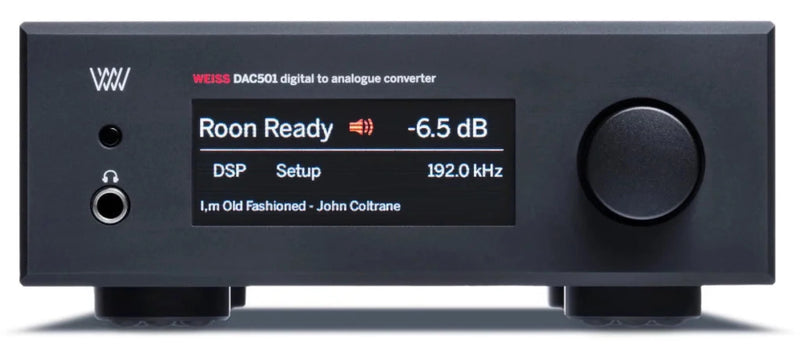


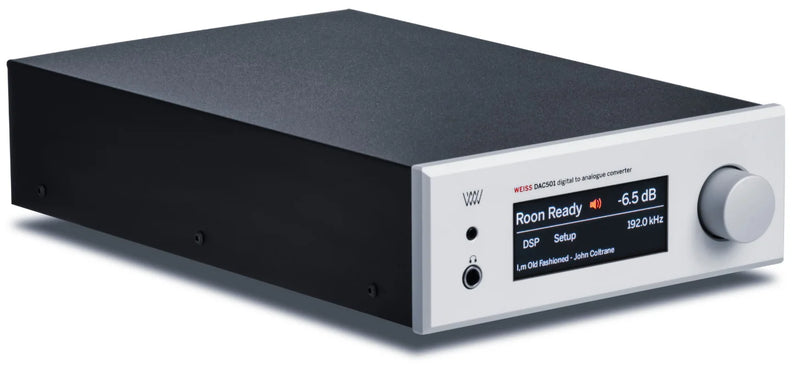

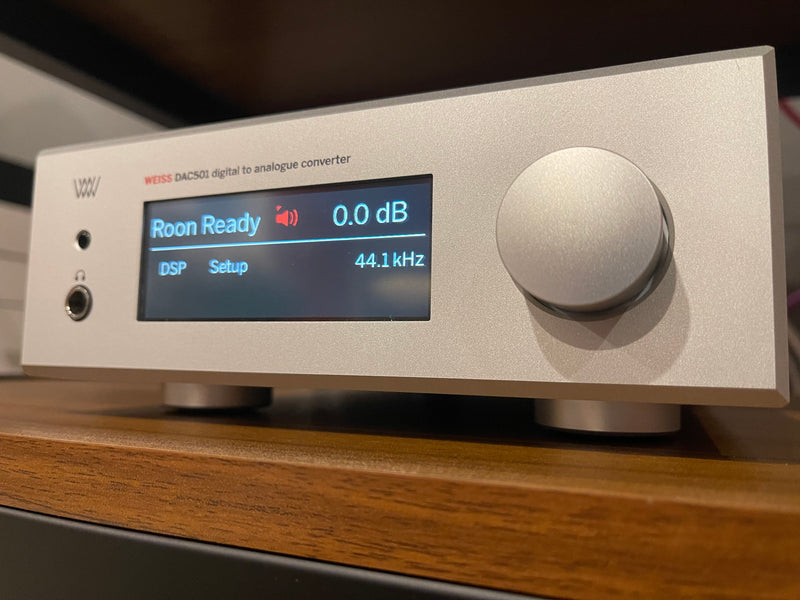

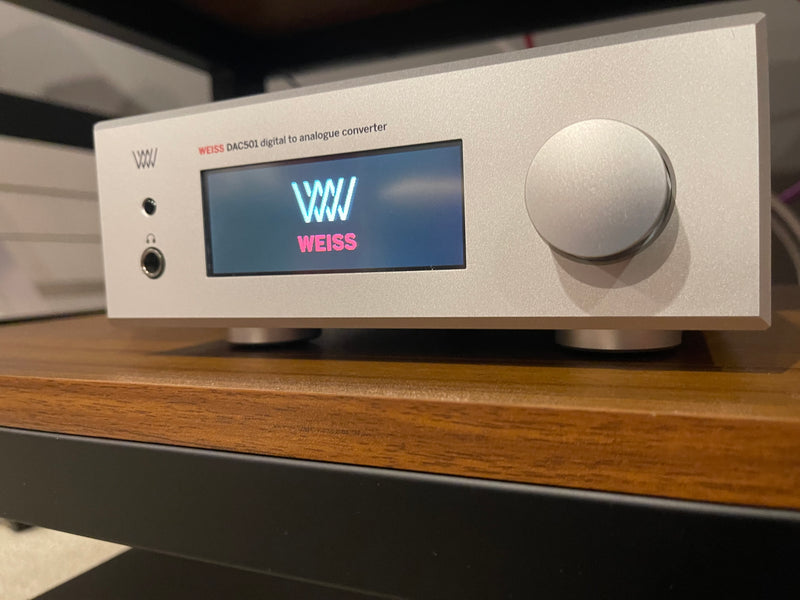


Weiss DAC501 MK2 Streaming DAC
A Swiss reference DAC and streaming hub, designed by a Technical GRAMMY winner, built to the standard of the mastering studio.
When the source is the thing holding your system back
You've put real money into your amplifier and speakers, and most of the time the system sings. But a lot of digital sources resolve the top end cleanly while flattening what sits underneath, the weight of a piano chord, the space between instruments, the low-level texture in a voice. The result sounds technically correct but never quite draws you in, and long listening sessions start to feel tiring rather than involving.
Why we chose the DAC501 MK2
The person who designed the conversion here is Daniel Weiss, one of the pioneers of digital audio and a 2021 Technical GRAMMY recipient, in the company of Ray Dolby, Rupert Neve, and Robert Moog. Weiss has spent decades building the tools that mastering engineers use to finish records, where the reference is not what sounds pleasant but what sounds accurate. The MK2 brings that standard home. Its updated analog conversion module, four ESS Sabre Pro 9038 chips run two per channel, sits behind a non-switching linear power supply with separate regulation for the left and right channels. The result is resolution without edge, the ability to hear what is actually in the recording without the digital glare that makes a system fatiguing.
What the specs won't tell you
Quiet details finally come through. With a signal-to-noise ratio better than 128 dB, the noise floor sits low enough that room ambience, the decay of a note, and the breath before a vocal are audible instead of buried. That is what separates a source that sounds correct from one that pulls you into the performance.
Bass that holds its shape at any volume. Separate power regulation between channels keeps the low frequencies clean where most DACs either lose definition or add bloom. Bass lines stay articulate at low listening levels and do not soften or compress when you turn it up, which matters in a capable, well-set-up room.
A stereo image that stays put. Channel crosstalk better than −110 dB across the full 20 Hz to 20 kHz band means instruments and voices hold a consistent place rather than drifting with the dynamics. Because the two channels are genuinely isolated, width and depth stay stable.
What the press heard
Reviewing the MK2 in December 2024, Steve Huff wrote that it takes the original to new levels of solidity, richness, and transparency, and concluded plainly that he knows of no other DAC he would rather own in its price bracket.
The DAC501 platform earned a Stereophile Class A+ Recommended Component rating, where Jason Victor Serinus described it as uncannily open and detailed, incisive and revealing, and John Atkinson's measurements praised its astonishing resolution. The MK2's four-chip analog module builds directly on that platform.
The Audio Two verdict
The DAC501 MK2 makes the most sense in a system where the amplifier and speakers are already good enough to show small changes clearly. It does not add a character of its own. It removes the character most DACs add by accident, and what remains is the recording. It also happens to be a full Roon Ready streaming endpoint, a preamp, and a headphone amp in one compact Swiss-built box, so it can be the digital heart of the system rather than one more thing on the rack.
"I know of no other DAC I would want to own in this price bracket." — Steve Huff, Steve Huff Hi-Fi, December 2024
Tech you can hear
| What You Hear | Why It Happens |
| Quiet detail and room ambience come through clearly | Signal-to-noise ratio better than 128 dB |
| Bass stays articulate at any volume | Non-switching linear power supply with separate left and right channel regulation |
| The stereo image holds its position | Channel crosstalk better than −110 dB from 20 Hz to 20 kHz |
| Resolution without hardness on long sessions | Updated four-chip ESS Sabre Pro 9038 analog module, two per channel |
| DSP tools on hand when a room or recording needs them | Built-in room EQ, de-esser, vinyl emulation, and XTC crosstalk cancelling, all defeatable |
| Streaming built in, no extra box | Roon Ready endpoint over Ethernet |
Technical highlights
- Updated MK2 analog conversion module: four ESS Sabre Pro 9038 chips, two per channel
- Signal-to-noise ratio better than 128 dB; THD+N better than 115 dB; crosstalk below −110 dB (20 Hz–20 kHz)
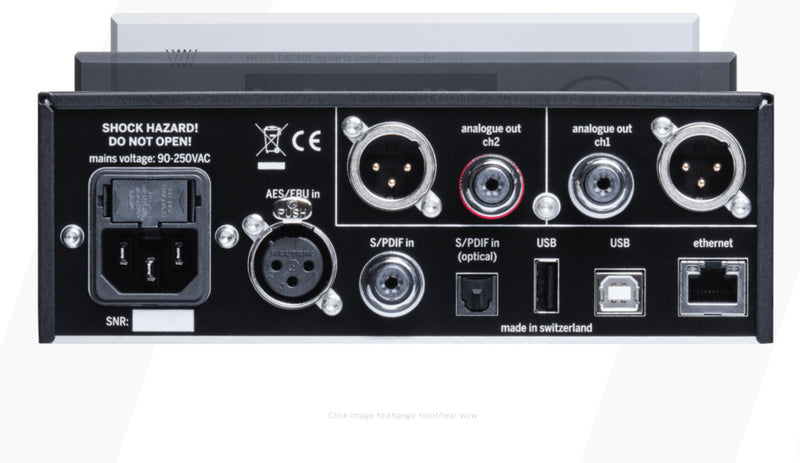
- Digital inputs: USB, AES/EBU and S/PDIF (XLR, RCA, Toslink), Ethernet (Roon Ready, UPnP/DLNA)
- Analogue outputs: balanced XLR and unbalanced RCA, plus a front-panel ¼" headphone output
- Formats: PCM up to 384 kHz / 32-bit, DSD64 and DSD128
- Non-switching linear power supply with separate regulation per channel; discrete line and headphone output stages
- Onboard DSP: room EQ, creative EQ, de-essing, vinyl emulation, XTC, crossfeed, headphone EQ
- Built in Switzerland; available in silver or black
Why choose Audio Two
A purchase at this level deserves more than a product page. Reach out to Audio Two and let's talk through your system, your room, and what you're trying to achieve. We work with clients across Canada on exactly these decisions.